Friday, October 9, 2026 | St. Lawrence County, NY
MASSENA — The Tim S. Dool has been refloated after running aground November 27.
According to GLS Administrator Adam Tindall-Schlicht, the vessel was freed on Dec. 16 after initially …
This item is available in full to subscribers.
To continue reading, you will need to either log in to your subscriber account, or purchase a new subscription.
If you are a digital subscriber with an active, online-only subscription then you already have an account here. Just reset your password if you've not yet logged in to your account on this new site.
Otherwise, click here to view your options for subscribing.
Please log in to continue |
 BY JEFF CHUDZINSKINorth Country This Week
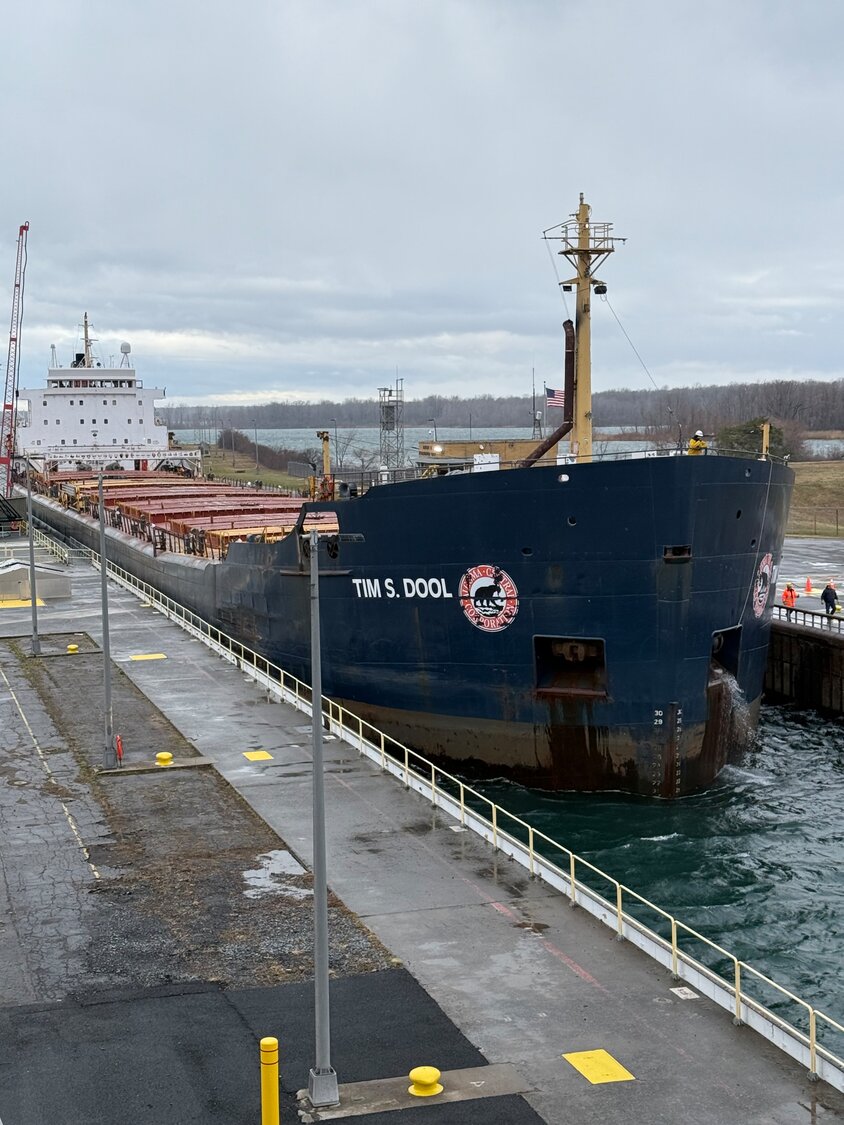
MASSENA — The Tim S. Dool has been refloated after running aground November 27.
According to GLS Administrator Adam Tindall-Schlicht, the vessel was freed on Dec. 16 after initially running aground on Nov. 23.
“After three weeks of hard work with our team, the Canadian Seaway team, other federal partners and the vessel owner we are excited to see a successful refloat,” Tindall-Schlicht said.
He commented the vessel then moved to anchorage at Wilson Hill to be inspected, including with underwater divers, to ensure the hull was in good shape and there was no environmental contamination.
“Both of those things were confirmed, the hull was in good shape and no contamination occurred,” Tindall-Schlicht said.
He also confirmed the crew was aboard the entire time,
“All accounts were that the health, wellness and livelihood during the time was they were good to go,” he said.
But the operation was an extensive one due in part to the age of the vessel, which was laid down in January 1967 and launched in October 1967.
While more modern vessels have conveyors and other systems to offload cargo, the Dool requires equipment to be brought in to offload.
In the case of the refloating operation, Tindall-Schlicht said barges were brought in with equipment to remove grain.
“Many ships that go through the Seaway are called self-loaders, where the actual equipment is already onboard for the loading and unloading of cargo. The Dool is not a self-loader, which required manual, ship-side intervention where buckets of grain had to be removed and put on barges to refloat the vessel,” he said.
Tindall-Schlicht said the refloat was a testament to the relationships and strong partnerships the GLS has with local and Canadian partners alike.
At the time of its grounding, the Dool was outside of the shipping channel and did not affect traffic on the Seaway, though vessels traversing that area were reported to be traveling slower than normal.
Efforts to refloat the Dool were carried out by Canadian Coast Guard, Great Lakes and St. Lawrence Seaway Development Corp. crews and the National Response Corp. , among other organizations.
The Dool successfully completed its voyage to Quebec on Dec. 16.